

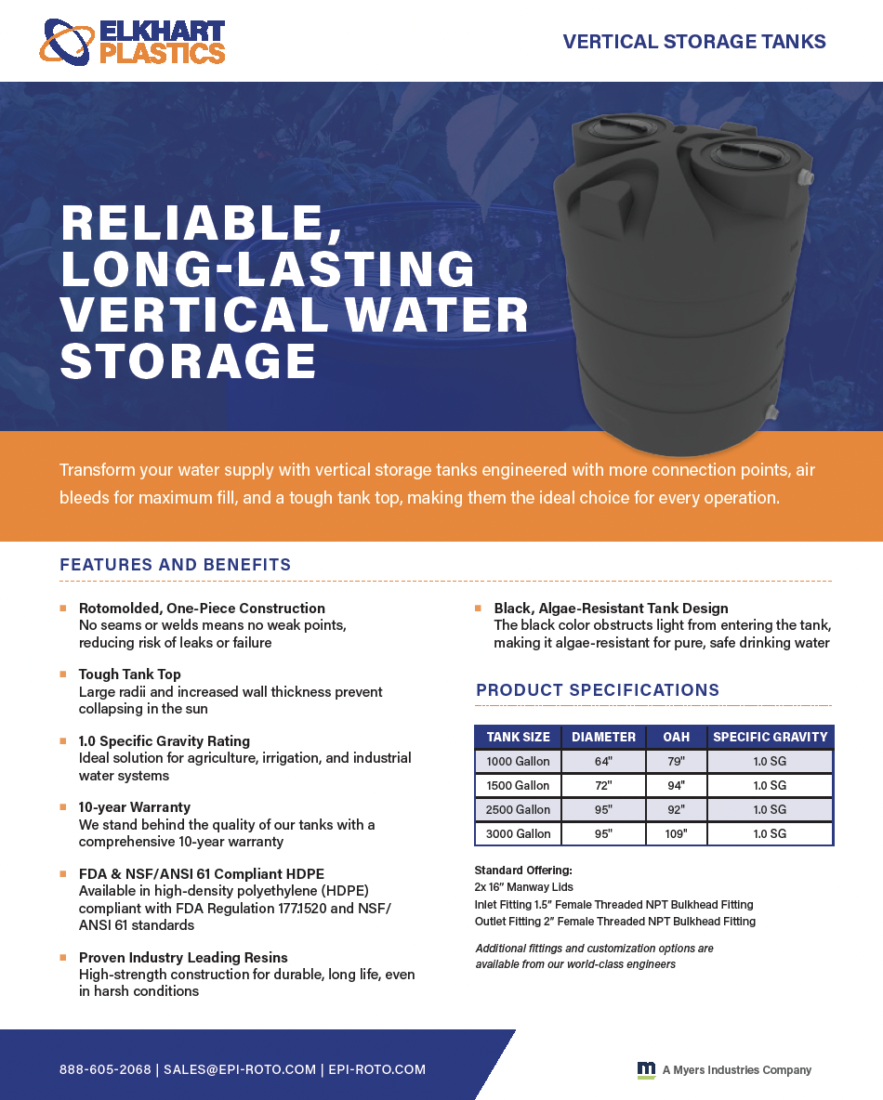
Vertical Storage Tanks
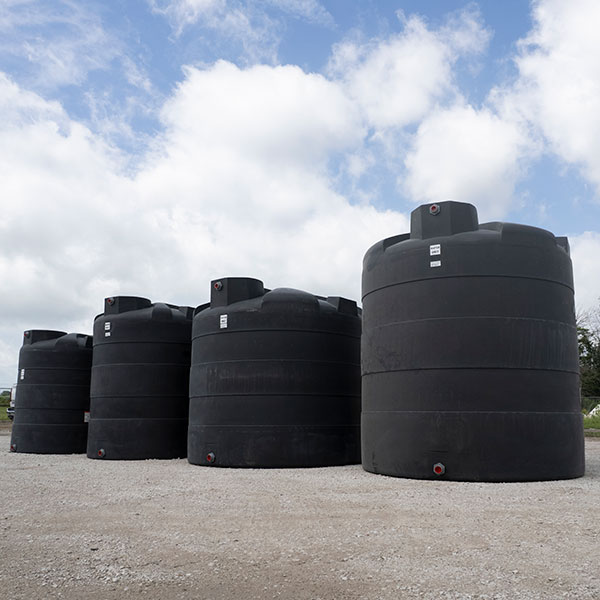
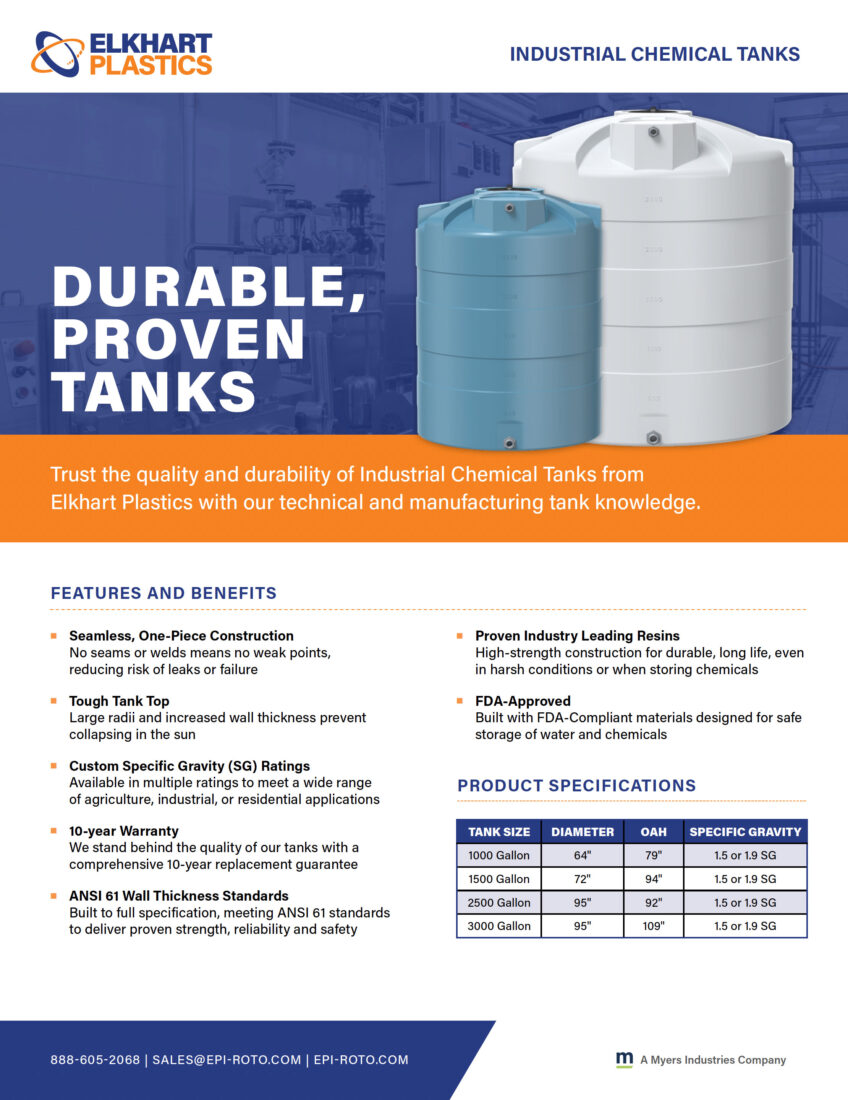
Durable, Proven Tanks
Vertical Storage Tanks for Water and Chemical Storage
Elkhart Plastics’ durable rotomolded vertical tanks are designed for safe, reliable storage of water, fertilizers, and liquid chemicals. Engineered for demanding environments, these tanks offer long-term durability, corrosion resistance, and dependable use across agricultural, irrigation, and industrial applications.
Our tanks incorporate features that simplify operations in the field, such as integrated connections, air bleeds, and rugged top designs.
Key features and benefits of our vertical storage tanks include:
- Resistant to chips, cracks, and ruptures from the rotational molding process
- Available in high-density polyethylene (HDPE) compliant with FDA Regulation 177.1520 and NSF/ANSI 61 standards
- UV-resistant HDPE for long-lasting outdoor protection
- 1.0 SG option for water storage; 1.5 or 1.9 SG options for chemical applications
- Additional fittings and customization options are available from our world-class engineers
- 5-year or 10-year warranties available
Our water storage tanks are available in a 1.0 specific gravity rating, making them ideal for agriculture, irrigation, and industrial water systems.
For chemicals and more demanding applications, 1.5 and 1.9 specific gravity options are available to safely handle corrosive materials, fertilizers, and other liquid chemicals.
To meet the needs of a wide range of operations, our vertical storage tanks are available in four convenient gallon capacities: 1000, 1500, 2500, and 3000.
Our Vertical Storage Tanks
Built for Strength and Reliability
Chemical Storage Tanks
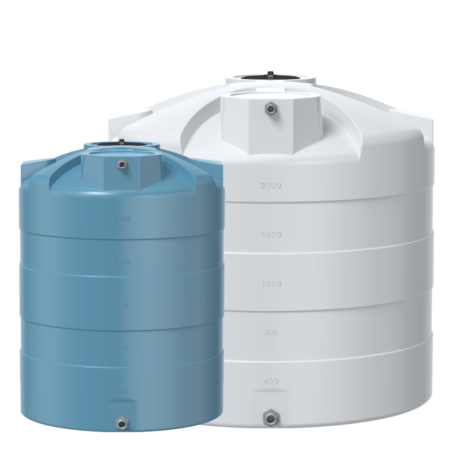
Chemical tanks with 1.5 or 1.9 specific gravity, engineered with more connection points, air bleeds for max fill, and a tough tank top, these storage tanks are the ideal choice in every operation.
View Product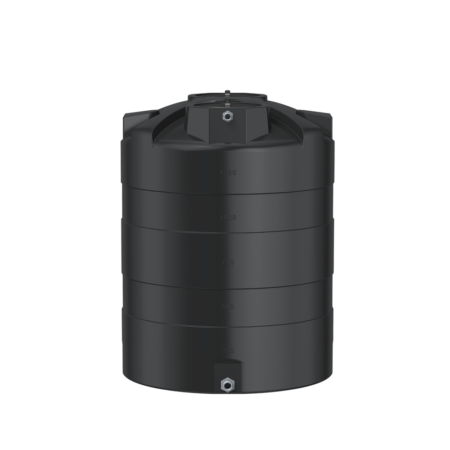
Water Storage Tanks
Water tanks with 1.0 specific gravity, engineered with more connection points, air bleeds for max fill, and a tough tank top, these storage tanks are the ideal choice in every operation.
View ProductTechnical Documents and Warranty Information
Download technical documents and warranty information. You can activate your warranty here or submit your warranty claim here.
Frequently Asked Questions
Technical Guide To Bulk Water and Liquid Storage Tanks
Please note: User is responsible for determining compatibility of chemicals with tank and fitting materials.
-
What materials are used to manufacture your poly tanks?
Elkhart Plastics manufactures tanks using high-density polyethylene (HDPE). The specific type of HDPE used depends on the tank size, as HDPE offers greater density, chemical resistance, and impact resistance compared to medium-density polyethylene. -
What chemicals can I store in your tanks?
User is responsible for determining compatibility of chemicals with tank and fitting materials. Identify the chemical(s) to be stored in the tanks. Be sure to obtain a Certificate of Composition, Material Safety Data Sheet (MSDS), or other relevant documentation from the chemical supplier to accurately identify the chemical compounds. This information is essential for evaluating the effects of the chemical on polyethylene storage containers. Ensure that the tank, fittings, and gasket materials are compatible with both the chemical and the anticipated storage temperatures. Refer to the Chemical Resistance Data Chart on page 15 to determine whether the chemical is compatible with polyethylene. If the resistance data does not list the chemical you intend to store, contact the chemical manufacturer for recommendations on storage in polyethylene tanks -
How heavy a material can polyethylene tanks hold?
Elkhart Plastics’ standard tanks are designed with a specific gravity rating listed on the tank. Our tanks, ranging in size from 50 to 3000 gallons have specific gravity design ratings listed on the tank. Specific gravity is defined as the ratio of a chemical’s weight per gallon to the weight of liquid per gallon (8.33 lb/gallon). For example, if a chemical weighs 10 lb per gallon, its specific gravity is calculated as 10.0 ÷ 8.33 = 1.2. (In metric units: kilograms per cubic meter or grams per liter.) Substances with a specific gravity greater than 1.0 are heavier than water, while those with a specific gravity less than 1.0 are lighter than water. -
What is the wall thickness of your liquid tanks?
The tank's wall thickness tapers from top to bottom. We carefully select the appropriate materials and resin grades to achieve the desired specific gravity. -
What are witness lines in liquid tanks?
Witness lines are visible imperfections in the finished product, caused by cracks that develop in the mold. These cracks typically occur in areas of the mold that experience the greatest stress, such as radiuses. When a crack goes undetected, the heat of the molding process allows molten plastic to seep into the crack, creating a witness line that mirrors the original mold defect. Running a fingernail across the witness line reveals that the plastic is protruding, rather than indented. In fact, the witness line can be scraped away, leaving a solid plastic surface. While unsightly, this cosmetic defect does not affect the structural integrity of the product. -
What is the warranty on your liquid tanks?
Elkhart Plastics warrants that the products sold to the purchaser meet the seller's specifications and are free from defects in materials and workmanship. This warranty lasts for five years from the original purchase date, unless the seller specifies otherwise in writing. However, the warranty can be extended to ten years if the original purchaser or end user registers the products with the seller within 30 days of the original purchase date. For full details, please refer to the complete warranty statement. -
Are your liquid tanks FDA compliant?
Elkhart Plastics manufactures liquid tanks using FDA-compliant resins. Our natural, black, blue, tan, and green colored tanks fully comply with current FDA standards for polyethylene tanks. However, certain colors, such as yellow, may affect compliance when blended into the resin. If FDA compliance is required, please specify this when placing your tank order, and we will assist you in selecting the appropriate color. -
Are your tanks FDA approved and are they safe for water storage?
Elkhart Plastics' above-ground tanks provide a safe solution for water storage. Our polyethylene tanks and polypropylene lids and fittings are manufactured using FDA-compliant materials. For information on additional FDA-approved color options, please contact our factory. -
Do your water tanks contain any BPA’s?
Elkhart Plastics' water tanks are manufactured using polyethylene, a plastic that does not contain bisphenol A (BPA). BPA is typically found in polycarbonate plastics and the epoxy linings of cans, but it is not used in the production of polyethylene. Polyethylene is a safe, non-leaching material that has been approved for direct food contact applications for decades. -
Are your above ground liquid tanks NSF approved?
The National Sanitary Foundation (NSF) evaluates multiple factors when granting approval, including the materials used and the final product configuration, such as any fittings and accessories that will be exposed to chemicals. Therefore, it is recommended to consult the manufacturer regarding the NSF approval status. -
Is there UV protection in the resin you use?
Elkhart Plastics' liquid tanks are molded from polyethylene compounded with the latest UV light stabilizer technology. These UV stabilizers are designed to mitigate the harmful effects of ultraviolet light exposure, extending the lifespan of the tanks compared to similar materials without stabilizers. Our standard UV rating is "15," meaning the tanks will retain 50% of their UV protection after 15,000 hours of sun exposure. However, this rating can vary based on location and duration of sun exposure, so we recommend consulting the factory for the specific UV rating of the product you intend to use. -
Do your tanks have a UL rating?
The UL 94 standard categorizes materials based on their flammability. Our polyethylene has a UL94HB rating, meaning it must not burn faster than 1.5 inches per minute for thicknesses between 0.120 and 0.500 inches, or 3 inches per minute for thicknesses less than 0.120 inches. Additionally, the specimens must extinguish themselves before the flame reaches 4 inches. -
Does the color of a water tank give any indication as to the quality of the tank?
Elkhart Plastics water tanks are made from polyethylene blended with ultraviolet (UV) stabilizers, which are designed to extend the tanks' lifespan by mitigating the harmful effects of UV light exposure. The standard tank color is black, but customers can opt for non-standard colors like green or tan. However, the tank color does not impact its UV resistance or longevity. It's important to note that the color may affect FDA compliance. -
Does the color of a water tank have an impact on Algae growth?
Black tanks are the most effective at preventing light transmission. While other highly concentrated colors can also eliminate translucence, the pigments act as contaminants when mixed with polyethylene, potentially weakening the tank. Green or tan tinted tanks (excluding black) typically allow enough light to sustain photosynthesis and promote algae growth. Therefore, one cannot definitively state that colored tanks do not promote algae without evaluating the specific level of light energy transmission. Any amount of light energy can enable algae formation. -
Can I store chemicals or fertilizers in Elkhart Plastics Water Only storage tanks?
No, Elkhart Plastics Water Only storage tanks with a specific gravity design rating of 1.0 are specifically designed for potable water storage and are not rated to hold chemicals, fertilizers, or any other substances besides clean water. -
Can I store Deionized water in your tanks?
Elkhart Plastics' polyethylene tanks can store deionized water at temperatures up to 100°F (38°C). -
Does the presence of ozone affect a polyethylene liquid tank?
Ozone is sometimes used for water purification. According to Ozone Solutions (http://www.ozoneapplications.com/), High Density Polyethylene (HDPE) has excellent compatibility with ozone, while polypropylene fittings are only rated as "fair" for ozone compatibility. As a result, polypropylene fittings are not recommended for continuous ozone exposure, as softening, loss of strength, and/or swelling may occur. However, the specific ozone concentrations used in the compatibility testing are not specified. Additionally, 100% ozone is not recommended for use in our tanks. To ensure safe operation, tanks should be inspected on a semi-annual basis. -
Can your Liquid Tanks be pressurized?
Our water tanks cannot be pressurized or exposed to vacuum. -
Can your Liquid Tanks be buried?
Our liquid tanks are not suitable for burial, as they are not engineered to withstand the pressure exerted by the surrounding soil. -
What is the maximum temperature that your liquid tanks can withstand?
Elkhart Plastics tanks can withstand sustained temperatures up to 120°F (49°C) and intermittent temperatures up to 140°F (60°C). However, exposure to higher service temperatures will lower the tank's specific gravity rating. -
How many years will my liquid tank last?
The life expectancy of a polyethylene tank is influenced by numerous factors, such as the stored material, indoor/outdoor placement, stationary or mobile use, and UV exposure, among other variables. -
Will freezing temperatures hurt my poly tank?
Polyethylene tanks are not affected by freezing temperatures. However, if you plan to store a liquid in the tank that may freeze, be sure to leave enough room for expansion. Keep in mind that polyethylene tanks have a greater risk of cracking during transport in cold weather. -
Is there some way to tell when my liquid tank was made?
All Elkhart Plastics water tanks are embossed with a date stamp in the month/year format. -
Are these tanks repairable through plastic welding?
Polyethylene tanks can be repaired by qualified personnel through welding. -
How tight can I tighten a bulkhead fitting?
To avoid damaging and leaking poly fittings, tighten the nut only to hand-tight plus a half-turn. Over-tightening can crack the fittings. If using thread sealant, ensure it is compatible with both the fittings and the chemicals they will contain. -
What type of surface is required for placement of a vertical liquid tank?
When selecting the tank site, ensure the area is level and has adequate drainage for liquid runoff. The tank bottom must be fully supported. For tanks over 1,000 gallons (3,785 liters), reinforced concrete support pads are recommended. Regardless of size, the base material must be designed to support the tank's bearing capacity, including seismic and wind loads. If the tank is on a stand or skid, the concrete or soil's bearing capacity requirements will increase. Always anchor the tank according to seismic or wind load zone requirements for the site. Consult applicable building codes for the specific support and anchoring requirements. -
Do you manufacture tanks made from Nylon materials?
Nylon has become a popular material in the rotational molding industry due to its notable properties. It is best known for its strength, resistance to creep and fatigue, and ability to withstand high service temperatures. Nylon also offers excellent chemical resistance to a wide range of substances, including gasoline and diesel fuel. Elkhart Plastics can manufacture tanks made from Nylon in sizes up to 20 gallons. -
Can I paint my tank?
Elkhart Plastics does not endorse the use of products claiming successful adhesion to polyethylene. While paints with adhesion promoters may initially adhere, they will eventually peel due to polyethylene's high thermal expansion and contraction. This thermal instability inherent to polyethylene leads to long-term adhesion failure, undermining the effectiveness of such paint products.